Local detail
The Cost of This Job
What you pay depends on what's already on your garage ceiling. A lot of houses in this area went up between 1951 and 1985, with the median landing around 1972, and that era of garage wiring was built for one job: run a light and a chain-drive opener, nothing more. Adding battery backup to a unit like that usually means swapping the opener itself, not just bolting on an accessory, because older openers don't have the circuit board to take a backup pack.
Median household income across the service area sits at $128,163, and with 33,212 owner-occupied houses built mostly in that same 1960s-70s window, a full opener replacement with battery backup is a common, affordable call here rather than a luxury upgrade. We'll price the job off what opener you have now and whether your panel needs any work to support it - we don't do electrical panel upgrades ourselves, so if your box needs more than a dedicated circuit, that's a separate call to an electrician before we finish the opener install.
If your opener still runs fine and you just want backup power, that's a cheaper job than a full swap. We'll tell you straight which one you actually need.
The area
What the Weather Here Does to It
This area sits in a mild temperate band, which means your opener motor isn't fighting the hard freezes or triple-digit heat that burn out capacitors and seize gears in other parts of the country. That's the good news, and it's real: a chain-drive opener from 1975 in a mild climate can keep running long after the same unit would've failed somewhere with real winters.
The bad news is that mild weather doesn't fix old wiring. Houses built in the 1951-1985 stretch that makes up most of this area's housing stock were wired for a single-purpose circuit, and that circuit doesn't care what the thermometer says outside. When the power goes out - for any reason - an opener with no battery backup just stops, full stop, regardless of how gentle the local climate has been to the motor itself.
So the climate here buys your opener a longer working life than it would get elsewhere, but it does nothing for what happens the moment the power cuts. Those are two separate problems, and treating them as one is how people end up stuck outside their own garage in a storm that barely qualifies as weather.
What we find
The Problem
The problem isn't the door. It's that a 1972-era house with its original or first-generation opener was never built with a backup plan for a power cut, and across 33,212 owner-occupied houses in this area built mostly in that same window, that's a lot of garages with the same gap.
When power drops, a standard opener goes dead. If you know where the manual release cord is and your springs are in good shape, you can pull it and lift the door by hand - that part isn't hard. The trouble starts when people don't know that cord exists, or haven't touched it in years and it's seized, or the door is heavy enough that lifting it by hand isn't something everyone in the house can do.
This is a wiring-era problem more than a weather problem. The mild climate here means the motor itself often still works fine decades in; it's the lack of battery backup, original to houses from this period, that turns an ordinary outage into someone stuck in the driveway. We see this across the area - Twin Lakes, Live Oak, Capitola, Soquel, Felton, Scotts Valley - wherever the housing stock dates back to that same 1951-1985 build-out.
How we work
What to Check
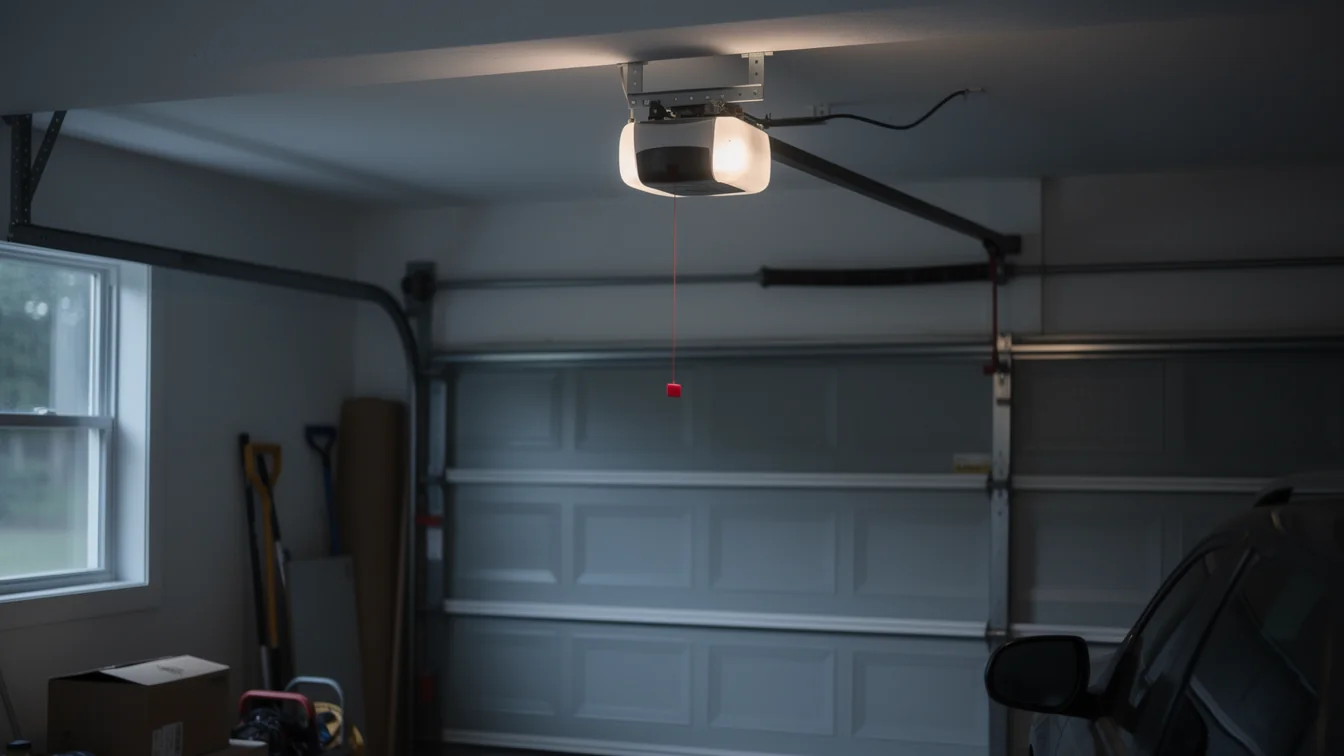
Start with your opener's age. If it predates the last ten or fifteen years and your house falls into the common 1951-1985 build range for this area, it almost certainly has no battery backup - check for a small battery compartment on the opener head unit; if there isn't one, there's no backup.
Next, find the manual release cord, usually a red handle hanging from a track near the opener, and pull it once while the door is down so you know it moves freely. A seized release cord on an original 1960s-70s installation is common enough that it's worth checking before you need it in an outage, not during one.
Third, check your garage outlet. Many houses built in this stretch wired the opener into the same circuit as the garage light, with no dedicated outlet at all - that matters if you're planning to add a battery backup unit later, since some units need their own circuit.
If you're close to the coast side of the area - Opal Cliffs, Twin Lakes - or further out toward Felton or Scotts Valley, the housing ages run similar enough that the same checklist applies either way. We don't do panel work, so if the outlet check turns up a shared or undersized circuit, that's worth a call to an electrician first.
Talk to a local pro
Garage door trouble in Santa Cruz?
Same-day service with honest, upfront quotes.